
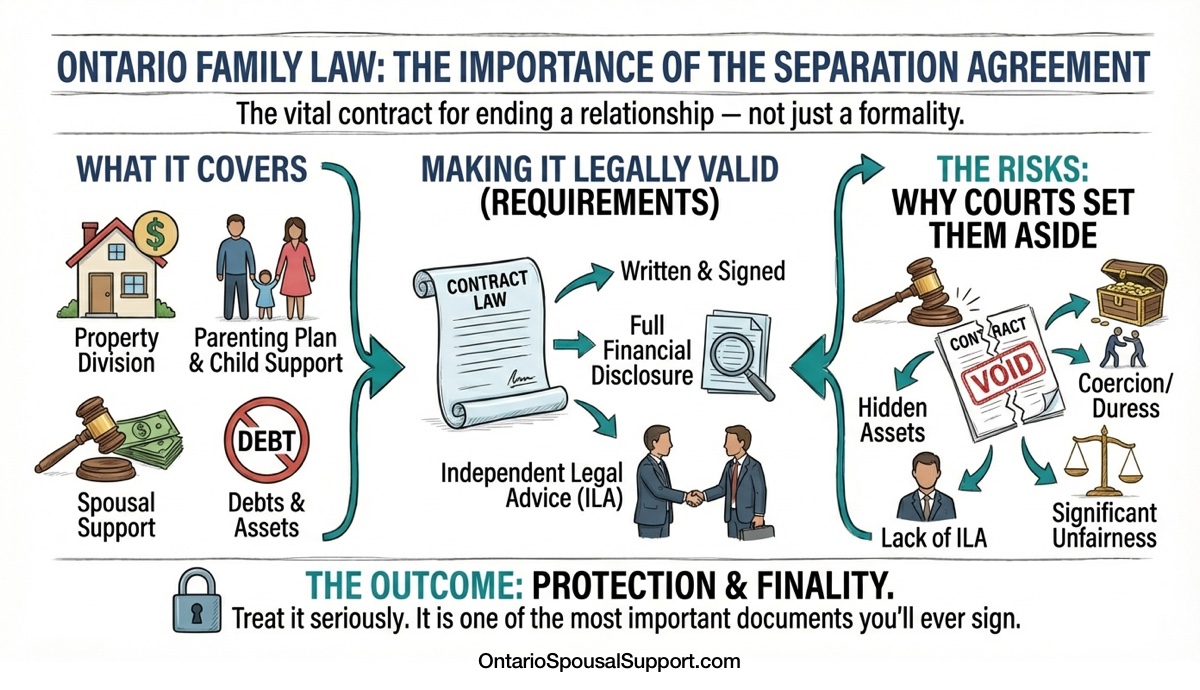
When a marriage or relationship breaks down in Ontario, most couples eventually need to put their agreement in writing. That written contract is called a separation agreement — and it's one of the most important documents you'll ever sign.
The problem is that many people treat it as a formality. They find a template online, fill in the blanks, both sign it, and assume it's done. It's not always that simple. Courts set aside separation agreements regularly — often because of steps that were skipped or information that wasn't disclosed.
This article explains what a separation agreement covers, what makes one legally valid in Ontario, and the specific things that can get your agreement thrown out later.
What Is a Separation Agreement?
When there is a breakdown of a marriage or relationship, the couple may be able to negotiate some or all of their issues and reach an agreement. That agreement, when put into writing, is a contract known as a separation agreement.
A separation agreement can be negotiated with or without lawyers. It can take place anywhere — at home, in a mediator's office, or even on the steps of the courthouse. And it doesn't have to come before court proceedings. Many couples go partway through litigation, realize that cooperation is cheaper than fighting, and negotiate an agreement to settle the remaining issues.
What Can It Cover?
A separation agreement can include almost any issue arising from your separation. Common topics include:
- Spousal support — how much, for how long, and under what conditions it ends or changes
- Child support — base amount, special and extraordinary expenses, and review terms
- Custody and parenting — decision-making authority, parenting schedules, holiday arrangements
- Access — how the non-primary parent will spend time with the children
- Property division — who keeps what, how assets and debts are divided, equalization payments
- The matrimonial home — sold, bought out, or who stays during the transition
- Special expenses — extraordinary costs like post-secondary education, medical expenses, or activities
In short: if it matters to your separation, it can go in the agreement.
Three Things That Make a Separation Agreement Valid
There are many websites offering templates for you to draft your separation agreement yourself. Be wary. Simply because you and your spouse both sign a separation agreement does not mean it is valid.
Courts do challenge and set aside separation agreements. Here are the three things that determine whether yours will hold up:
1. It Has to Say What You Actually Intend
Separation agreements must be skillfully drafted to ensure they actually provide for what the couple intends. Vague language, missing provisions, or clauses that contradict each other can all cause problems down the road — sometimes leaving a critical issue unresolved, sometimes creating an obligation neither party meant to create.
Lawyers who draft separation agreements regularly are aware of provisions you may not think to include. A clause that seems unimportant now — such as a release of future spousal support claims, or a provision about what happens if one party doesn't pay — can become the most important sentence in the document years later.
2. Both Parties Must Make Full Financial Disclosure
This is the most common reason agreements get set aside. The key to creating a separation agreement that will stand the test of time is full and frank financial disclosure.
If you negotiate a separation agreement on the basis of false or misleading financial disclosure, your spouse can apply to the court to have the agreement set aside. If you provide incomplete or misleading disclosure and assume no one will find out, you may end up paying more in legal fees or receiving a costs award against you.
Parties often unintentionally provide incomplete or incorrect disclosure. Whether it's intentional or not, inaccurate information can undo an agreement that both parties signed in good faith.
For married spouses, complete financial documentation is required showing the value of all assets and liabilities as of two dates: the date of separation and the date of marriage. You must also provide documentation for any asset you believe should be excluded from your net family property — such as gifts or inheritances.
3. Both Parties Should Get Independent Legal Advice Before Signing
Independent legal advice (ILA) means each of you has your own lawyer — not a shared one — review the agreement and explain what you're agreeing to before you sign it. One of the major factors courts consider when deciding whether to uphold a separation agreement is whether both parties were educated about their rights and obligations, and whether they received ILA prior to signing.
Even if you and your partner choose to draft the agreement yourselves without a lawyer's involvement, it is still important for both of you to receive ILA before signing. The drafting is separate from the advice. You can write the agreement yourselves and still each have a lawyer review it at the end.
What Financial Disclosure Actually Looks Like
Financial disclosure isn't just "tell your spouse what you earn." It's a formal exchange of documentation. Courts require sworn, detailed, and accurate financial disclosure — and the same standard applies if you're settling out of court.
Generally, required disclosure includes:
- Financial statements — Form 13 (for support claims without a property claim) or Form 13.1 (for property claims)
- Personal income tax returns with all schedules and attachments, for the three most recent years
- Notices of Assessment for the three most recent years
- Recent pay stubs
- Bank statements
- Credit card statements
- If claiming child support: proof of any special or extraordinary expenses under section 7 of the child support guidelines
This is not an exhaustive list. Depending on your situation — self-employment, business ownership, investment income — additional documents may be required. See our article on self-employed income and spousal support for more on how courts treat business income.
The Spousal Support Release Clause: Read This Before You Sign Away Your Rights
As part of a separation agreement, you and your spouse may include a clause releasing both of your rights to spousal support. This clause is usually included after a lump-sum payment or after a periodic support amount has been agreed to.
It is technically possible to have a release clause set aside later — but the test is a significant burden. The Supreme Court of Canada addressed this in Miglin v. Miglin. You should proceed on the assumption that such a clause will be enforced.
The factors that make it more likely a court will set aside a spousal support release clause include:
- A spouse failed to disclose income, significant property, debts, or other relevant information
- A spouse took improper advantage of the other's vulnerability — including ignorance, need, or distress
- There were significant power imbalances at the time the agreement was made
- A spouse did not understand the nature or consequences of what they were signing
- Any other circumstances that make the agreement "significantly unfair"
Professional advice from a qualified lawyer may help compensate for a vulnerability or power imbalance — but it will not automatically do so.
For more on lump-sum payments vs. ongoing monthly support, see our article on lump sum vs. monthly spousal support.
The Tax Rule Nobody Mentions Until It's Too Late
Spousal support payments are only tax deductible to the payor — and only taxable as income to the recipient — if they are made pursuant to a written separation agreement or court order, paid on a periodic basis (weekly or monthly).
This means: if you and your spouse verbally agree that one will pay the other a monthly amount, and you never put it in writing, the payor cannot deduct those payments and the recipient does not have to claim them as income. That may sound appealing — but it also means the CRA will not recognize the arrangement, and either party can walk away from it at any time without legal consequence.
A written separation agreement is the document that triggers the tax treatment. Without it, the support isn't deductible, isn't enforceable through the Family Responsibility Office, and has no legal standing.
For a full breakdown of the CRA rules, see our article on CRA tax rules for spousal support.
Can You Change a Separation Agreement Later?
It is harder to change a separation agreement than to change a court order. Separation agreements are contracts, and courts are reluctant to override them.
However, if circumstances have changed dramatically and enforcing the agreement would be unconscionable, courts may vary it. If your agreement says support is "final" or "non-variable," you'll face an even higher bar to change it.
For illustration: if you and your spouse agree to a fixed monthly spousal support amount and your income later drops significantly, you may want to apply to have it varied. A court will look at whether the change in circumstances was significant and wasn't anticipated when the agreement was made — and whether the original agreement was fairly made to begin with. If you signed an agreement without full disclosure from the other side, that weakness may actually work in your favour on a variation application.
For more detail, see our article on modifying spousal support in Ontario.
Do You Need a Lawyer?
The short answer: both parties should receive independent legal advice before signing. That doesn't necessarily mean hiring a lawyer to handle your entire case.
Unbundled Legal Services (Limited Scope Retainers)
Some people prefer to handle parts of their family law matter themselves, whether because of cost or preference. Many Ontario lawyers offer what are called limited scope retainers or unbundled services — where they assist with a specific part of the process rather than the entire case.
A limited scope retainer for a separation agreement might include:
- A one-time consultation to understand your rights and obligations
- Review of a separation agreement you've drafted yourself
- Preparation of specific clauses
- Independent legal advice certificate — confirming that you received advice before signing
- General coaching or behind-the-scenes mentoring as you negotiate
Not every lawyer offers unbundled services, but many do. It is worth asking. The cost of an ILA review is significantly less than the cost of having a court set aside your agreement years later.
Your Will and Your Estate: What Changed in 2025
This section surprises a lot of people — and the rules recently changed in a significant way.
Before 2025, separation alone did not affect your Will. A separated spouse retained all inheritance rights until a legal divorce was finalized. Long-separated couples with new partners and separate lives were still legally entitled to inherit from each other — a gap in the law that produced some genuinely unintended outcomes.
That changed as of January 1, 2025. Ontario amended the Succession Law Reform Act (SLRA) so that separated spouses are now largely treated the same as divorced spouses for inheritance purposes.
What the New Rules Mean
If spouses meet Ontario's statutory definition of "separated," the following now applies automatically:
- Gifts in a Will are revoked. Any bequests, executor appointments, or trustee roles given to a separated spouse are treated as if that spouse died before the testator. They receive nothing unless the Will explicitly states otherwise.
- No intestate inheritance rights. If you die without a Will, a separated spouse is not entitled to inherit — the same treatment as a divorced spouse.
When Are You Legally "Separated" Under the New Rules?
A spouse qualifies as separated — and loses automatic inheritance rights — if any one of the following existed before death:
- Living separate and apart for at least three years due to marriage breakdown
- A valid separation agreement is in place
- A court order resolving marital issues
- An arbitration award addressing spousal rights
What the SLRA Does Not Cover
The 2025 amendments affect Wills and intestate succession. They do not automatically update:
- Beneficiary designations on life insurance policies, RRSPs, TFSAs, and RRIFs
- Joint ownership arrangements
- Trust structures
These assets typically pass outside the Will entirely — which means the SLRA changes do not touch them. A separated spouse named as beneficiary on your RRSP will still receive those funds even if the new rules strip their Will entitlements. You need to update beneficiary designations separately.
The bottom line: whether or not the new rules remove your spouse's inheritance rights automatically, you should update your Will after separation. Do not leave it to the statute to sort out — review your estate plan, your beneficiary designations, and your Will with a professional.
Documents to Gather Before You Start Negotiating
Before you sit down to negotiate anything, get your documents organized. Both parties will need these — for disclosure purposes, for lawyers, and potentially for court:
- Marriage certificate (original)
- Existing Will
- Any existing marriage contract or prenuptial agreement
- Any existing cohabitation agreement
- Any existing interim court orders
- Personal income tax returns for the last three years, including all schedules
- Notices of Assessment for the last three years
- Recent pay stubs (last five)
- Bank and investment account statements
- Credit card statements
- Employment contract
- Group insurance and employee benefits booklets
If you are self-employed or own a corporation, you will also need business financial statements and additional documentation. See our article on self-employed income and spousal support.
The Bottom Line
A separation agreement is the most efficient way to resolve your separation — cheaper and faster than litigation, and legally binding if done right. But "done right" has specific requirements in Ontario. The three that matter most:
- The agreement must say what you actually intend. Vague drafting creates future disputes.
- Both parties must make full financial disclosure. Skipping this is the most common reason agreements get set aside.
- Both parties should get independent legal advice before signing. Even a one-time ILA consultation significantly strengthens the agreement's enforceability.
Before you finalize any numbers, use our Spousal Support Calculator and Property Division Calculator to understand what the SSAG guidelines suggest for your situation. Walking into negotiations with accurate numbers gives you a much stronger starting point.