
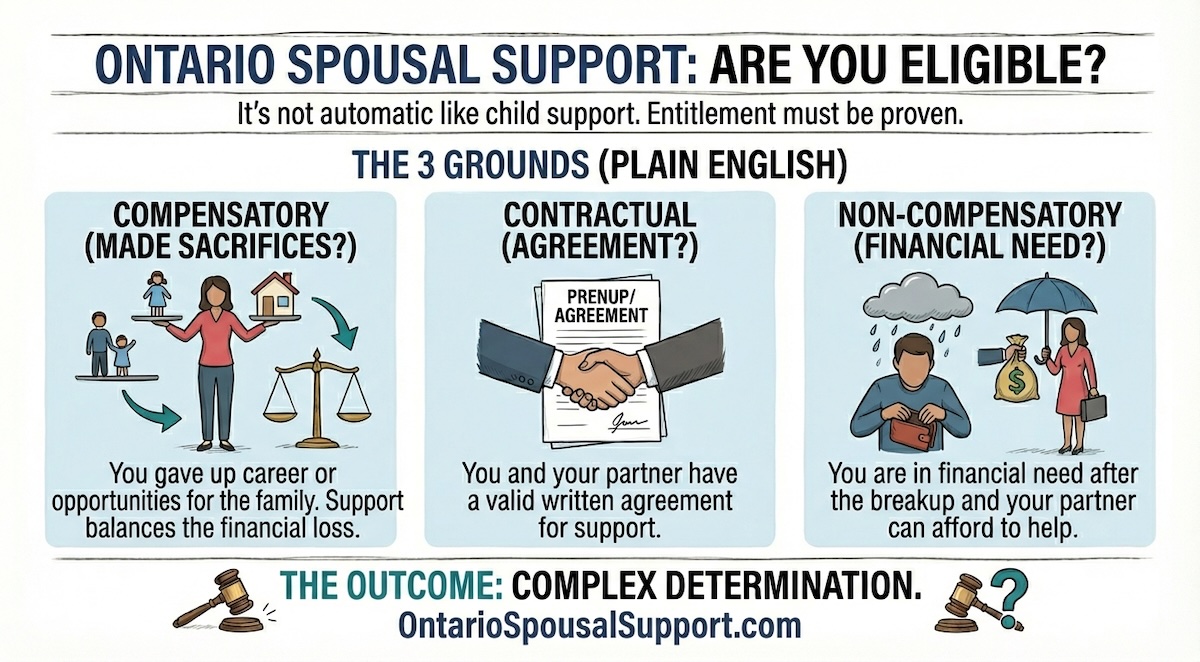
Most people jump straight to the numbers. How much? For how long? But there's a threshold question that comes before any of that: are you actually entitled to spousal support in the first place?
Unlike child support — which is owed automatically when a child lives primarily with one parent — spousal support has no automatic entitlement. Not everyone who separates qualifies. The determination is complex and depends on the specific circumstances of your relationship.
This article walks through who qualifies, the three legal grounds for entitlement, what factors courts look at, and the common misconceptions that catch people off guard.
The Foundation: Spousal Relationships as Financial Partnerships
The law views spousal relationships as financial partnerships. When that partnership breaks down, the spouse with more income may be required to support the other — provided they have the means to do so.
Spousal support is intended to:
- Recognize any financial advantages or disadvantages to each spouse as a result of the relationship or its breakdown
- Share the financial consequences of caring for a child, over and above any child support obligation
- Relieve financial hardship
- Help a spouse become self-sufficient
These goals fall into two broad categories: compensatory (addressing economic disadvantage created by the relationship) and non-compensatory (addressing financial need regardless of how that need arose).
Who Can Claim: The Relationship Threshold
Before getting to the grounds for entitlement, you need to meet the basic relationship threshold. Entitlement to spousal support is not dependent on gender — either spouse can be the payor or the recipient.
Married Spouses
If you were legally married, you automatically meet the relationship threshold. The question then becomes whether entitlement exists on one of the three legal grounds below.
Common Law Partners in Ontario
You do not have to be legally married to receive or be ordered to pay spousal support. In Ontario, common law partners meet the threshold if:
- You lived together continuously for at least three years, OR
- You were in a relationship of some permanence and have a child together
If neither condition is met, there is no spousal support obligation between common law partners in Ontario — regardless of income difference or length of the relationship. For more detail, see our article on common law spousal support in Ontario.
The Three Grounds for Entitlement
The leading Supreme Court of Canada case on spousal support entitlement is Bracklow v. Bracklow [1999] 1 S.C.R. 420. It established three grounds on which entitlement can be based. A spouse only needs to establish one of the three.
Ground 1: Compensatory
Compensatory support is intended to compensate a spouse for economic disadvantage suffered as a result of the marriage or its breakdown.
This is the most commonly understood ground. Classic examples:
- A spouse who gave up their job or career to care for children
- A spouse who gave up education or career opportunities to support the other's career advancement
- A spouse who relocated for the other's work, sacrificing their own professional network
The longer the marriage and the more significant the career sacrifice, the stronger the compensatory claim. A spouse who worked throughout the marriage in their own career, with no interruption, has a weaker compensatory argument than one who left the workforce entirely.
Ground 2: Contractual
Contractual entitlement arises where there is an expressed or implied agreement that the spouses were responsible for each other's support. This could come from a formal marriage contract or separation agreement, or from the implicit understanding built up over the course of a long marriage where one spouse was financially dependent.
In long marriages with a traditional financial arrangement — one spouse earns, the other manages the household — courts may find a contractual basis for support even without a written agreement.
Ground 3: Non-Compensatory (Needs-Based)
Non-compensatory support is the most straightforward: one spouse is in financial need, and the other has the means to help. It does not require proof that the marriage created the need.
This ground reflects the view that the primary burden of meeting a dependent spouse's needs falls on the other spouse, rather than on the state. Even if a spouse had no career sacrifice and no explicit agreement, need alone — combined with the other spouse's ability to pay — can establish entitlement.
What Does NOT Affect Entitlement
Misconduct and Adultery
This surprises many people: misconduct during the marriage is not to be considered when determining spousal support. Adultery, infidelity, or other marital misconduct — no matter how significant — does not affect whether spousal support is owed or how much.
Spousal support is calculated on financial factors: income difference, length of the relationship, roles performed, and need. The reason the marriage ended is irrelevant to the support calculation.
Who Filed for Divorce
Who initiated the separation or divorce has no bearing on entitlement. Either spouse can be the payor or recipient, regardless of who left whom.
Lower Chance of Entitlement: When Support Is Less Likely
Entitlement is not guaranteed just because there is an income difference. Courts are less likely to order spousal support when:
- Both spouses are fully capable of supporting themselves
- The couple kept their finances largely separate throughout the relationship
- The relationship was short and neither spouse made significant sacrifices for the other
- Both spouses maintained their own careers and earning capacity
For illustration: two spouses who both worked professional careers throughout a five-year marriage, maintained separate finances, and had no children, may find that neither has a strong entitlement claim — even if their incomes differ significantly.
The Duty to Become Self-Sufficient
Both spouses have an ongoing obligation to make reasonable efforts to become economically self-sufficient. This duty affects not just entitlement, but duration and amount.
Self-sufficiency is measured against the standard of living the couple had before separation — not some abstract minimum. A spouse who was accustomed to a comfortable lifestyle is not expected to take any available minimum-wage job to achieve "self-sufficiency."
That said, the duty is real. A recipient who makes no effort to work, upgrade skills, or re-enter the workforce when reasonably able to do so may find their support reduced or terminated. The duty to strive toward self-sufficiency never ends — it continues throughout the support period.
Courts also recognize that patterns of marital dependence can make self-sufficiency genuinely difficult. A spouse who was out of the workforce for many years may face real barriers — outdated skills, gaps in employment history, or childcare obligations — that justify a longer support period.
Special Situations That Affect Entitlement and Amount
Illness or Disability
An ill or disabled spouse who is unlikely to work again may receive a spousal support award that is higher than it would otherwise be. Since the spouse cannot self-support, courts may order support to ensure they are taken care of and, to the extent possible, do not become reliant on government assistance.
Support for an ill or disabled spouse is more likely to be awarded on a permanent basis. Courts have taken different approaches in these cases: some increase both the amount and duration, some stay within the standard SSAG ranges, and some extend the duration while keeping the amount at the lower end of the range. This is a complex and unsettled area — legal advice is strongly recommended if disability is a factor.
Imputed Income
Once entitlement is established, both parties must provide full financial disclosure. If a spouse fails to disclose assets or financial information, or if a spouse appears to be deliberately underemployed, a court can impute income — assigning an earning capacity rather than accepting a reported income at face value.
This works both ways. A payor who claims low income while concealing assets may have higher income imputed against them, increasing support. A recipient who appears capable of earning but is not working may also have income imputed, reducing the support they receive. For more, see our article on imputed income in Ontario divorce.
Entitlement vs. Amount: The Critical Distinction
The Spousal Support Advisory Guidelines (SSAG) are a widely respected tool that courts use to determine the appropriate amount and duration of support. But the SSAG does not address whether a spouse is entitled to support in the first place.
This is one of the most commonly misunderstood points about the calculator. Even if you run our calculator and it produces a support range, that does not automatically mean support is payable. Entitlement must be established first — by agreement between the parties, or by a court order. Only after entitlement is established does the SSAG become a useful tool.
The SSAG also does not cover every situation. Among the circumstances it does not address:
- Prior support obligations (a spouse already paying support from a previous relationship)
- Illness and disability exceptions
- Special needs circumstances
- The effect of remarriage or a second family on support obligations
- Payor income ceilings and floors beyond which the formulas don't apply in the standard way
Interim Support: Getting Help While You Wait
Family law cases can take a long time to resolve on a final basis. In the meantime, a spouse in significant financial need can apply for interim spousal support — a temporary order that applies until the final issues are determined.
Interim support is typically used where one spouse urgently needs financial assistance and the other has the means to provide it. It may also be ordered in situations where one spouse can afford legal counsel and the other cannot — to level the playing field during litigation.
To receive interim support, you must make a credible case for entitlement. Courts granting interim support will not conduct a deep analysis of all the facts — they look primarily at need and ability to pay. If entitlement is genuinely in dispute, courts are more cautious about ordering interim support.
Once Entitlement Is Established: What Comes Next
If entitlement exists — whether agreed to by the parties or ordered by a court — the next questions are how much and for how long. That's where the SSAG formulas come in.
Use our free Spousal Support Calculator to get your SSAG range based on your specific income figures, length of relationship, and whether children are involved. The calculator applies the three main SSAG formulas automatically:
- Without Child Support Formula — when there are no dependent children, or children are no longer dependent
- With Child Support Formula — when dependent children live primarily with the support recipient
- Custodial Payor Formula — when dependent children live primarily with the support payor
For a plain-language explanation of how those formulas work, see our article on how spousal support is calculated in Ontario. To understand what drives your number higher or lower within the SSAG range, see why your SSAG range is so wide.