
You built the corporation the right way.
Incorporated early. Kept your personal salary reasonable so you weren't handing the government more than you had to. Paid yourself dividends in good years. Left profits in the company when it made sense — to fund growth, smooth out the lean months, build something real.
Your accountant was happy. Your tax bill was manageable. The structure was working exactly as designed.
Then your marriage ended.
And now someone is about to sit down with three years of your T2 corporate returns, your financial statements, your shareholder loan account, and every personal expense that ever ran through that company — and build a version of your income that has almost nothing to do with what you paid yourself.
Here's what most incorporated business owners don't realize until it's too late: the same corporate structure that made you tax-efficient for the CRA makes you look like a high earner to a family court judge.
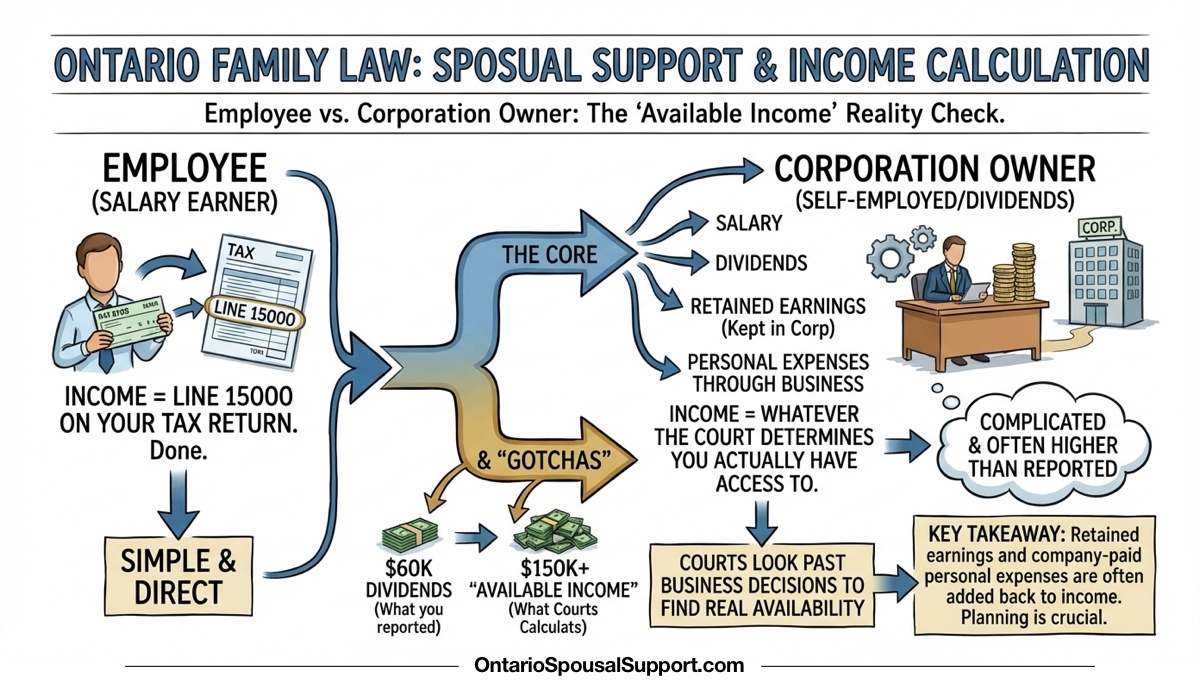
Because "income" for spousal support purposes isn't what you reported. It's what you had access to. Retained earnings sitting inside your corporation? Available. Personal expenses the business covered? Added back. Salary you could have taken but didn't? Courts can ask why not.
The gap between your T4 and what a court calculates as your income can be $50,000, $100,000, or more. And spousal support gets calculated on their number — not yours.
This is the private corporation gotcha. And it blindsides business owners constantly.
Here's exactly how courts calculate income when you own a private corporation in Ontario — and what that means for your support obligation.
The Private Corp Problem in 30 Seconds
For employees: Income = Line 15000 on your tax return. Done.
For private corporation owners: Income = Whatever the court determines you had access to — including profits left in the corporation, personal expenses the business paid, dividends you chose not to take, and retained earnings built up over years.
The gap: What you reported to CRA vs. what courts calculate for support can be dramatically different. Courts aren't bound by your tax strategy.
Why Your Personal Tax Return Only Tells Half the Story
For an employee, income is a closed loop. Employer reports it, CRA taxes it, Line 15000 reflects it. There's nowhere to hide and nothing to argue about.
When you own a private corporation, you have control employees never have:
- Pay yourself a salary, dividends, or a mix of both
- Leave corporate profits as retained earnings instead of paying them out
- Run legitimate personal expenses through the business
- Choose when to take money out — or whether to take it at all
- Build a holding company structure that adds another layer of complexity
Every one of these decisions was probably made for good reasons. In a divorce, every one of them gets scrutinized.
Courts look past the choices you made and ask the question that matters for support purposes: What did you actually have available to yourself?
What Courts Actually Dig Into
Forget the T4. When a private corporation is involved in an Ontario divorce, here's what ends up on the table:
1. Corporate Financial Statements
The income statement and balance sheet are where this starts. Courts and their experts examine:
- Gross revenue — What the business actually brought in
- Pre-tax profit — Revenue minus legitimate business expenses
- Retained earnings — Profits accumulated inside the company over time
- Shareholder loan account — Money you borrowed from or lent to the corporation
These aren't documents you hand over voluntarily. They're compelled through financial disclosure. Three years, minimum.
2. Personal Expenses Running Through the Corporation
This is where it gets uncomfortable fast. If your corporation pays for any of the following, those amounts get added back to your personal income for support calculations:
- Vehicle (lease, gas, insurance, repairs)
- Phone and internet
- Meals and entertainment
- Travel and accommodation
- Home office expenses
- Insurance premiums
- Professional memberships and dues
Completely legitimate for tax purposes. CRA doesn't care. But courts view every personal benefit the corporation provides as income you didn't have to spend your own money on — which means it flows back into the support calculation.
3. The Lifestyle Cross-Check
If the numbers don't add up, courts notice. Your personal return shows $90,000 in income. You own a $1.8 million home, lease a new Range Rover, and skied in Whistler twice this year. Courts can work backwards from how you actually live and impute income to match. The lifestyle doesn't lie even when the returns do.
4. Three Years of History
Courts look at income over three years to establish a pattern. One bad year doesn't reset your obligation. If your income happens to have "dropped" right around the time separation became likely, expect that timing to be scrutinized hard.
The Retained Earnings Trap
This one catches more incorporated business owners than almost anything else in an Ontario divorce.
You've been doing the smart thing — leaving profits inside the corporation. Lower personal tax now. Build a cushion. Fund expansion. Maybe use it as a retirement strategy. All of this makes complete sense.
In a divorce, that accumulated money inside the corporation can be attributed to you as income.
Example: The Retained Earnings Blindside
Sandra owns a marketing agency through a private corporation. Over eight years, she's paid herself $120,000/year but left an average of $60,000/year in the company. Retained earnings: $480,000.
Her position: "My income is $120,000. That's what I paid myself."
Court's position: "You had access to $180,000/year. Leaving $60,000 in the company was your choice — it doesn't reduce your available income."
Result: Support calculated on $180,000, not $120,000.
There are exceptions. If you can demonstrate the corporation genuinely needed those retained earnings — bank loan covenants require a cash reserve, you had a major equipment purchase, contractual obligations required it — courts may not attribute the full amount. But "I was building toward retirement" or "I like having a cushion" generally won't cut it.
Dividends vs. Salary: Courts Don't Care Which You Used
If you own a private corporation, you've probably been optimizing your salary/dividend split for tax efficiency. Smart. Courts don't care about the split.
Here's what each looks like on paper:
- Salary: Employment income on your T4
- Dividends: Income on your T5 slip
- Retained in the corporation: Doesn't show up on your personal return at all
For support purposes, all three streams get added together. The pre-tax corporate income that generated everything is what courts are working from — not the after-tax amount you actually pocketed.
Holding Companies and Complex Structures
If you've moved into holding company territory — a parent corporation that owns your operating company, or multiple corporations for different business lines — the complexity multiplies.
Courts consolidate. Moving money between related corporations doesn't make it disappear from the income analysis. Management fees paid between your companies, intercompany loans, income shifted to a holding company for investment — all of it gets examined as part of the full picture.
The more layers in your structure, the more expensive and time-consuming the income analysis becomes. That's not necessarily bad for you, but it means the CBV bill goes up and the process takes longer.
The Documents They're Going to Want
Private corporation divorce means a lot of paper. Here's what financial disclosure typically requires:
Personal Documents
- 3 years of personal tax returns (T1 General)
- Notices of Assessment from CRA
- T4s, T5s, and all other income slips
- Personal bank statements
- Personal credit card statements
Corporate Documents
- 3 years of corporate tax returns (T2)
- Financial statements — income statement and balance sheet
- General ledger or detailed accounting records
- All corporate bank statements
- Shareholder loan account documentation
- Any management fees or intercompany transactions
- Expense receipts (yes, all of them)
If You Have Multiple Entities or Professional Corporations
- Full documentation for each entity
- Details of any income-splitting arrangements
- Intercompany loan records
- Holding company financial statements
Being evasive or slow with disclosure is a bad strategy. Courts can draw negative inferences — essentially assuming the hidden information is worse than whatever you're actually hiding. Full disclosure, organized and clean, puts you in a better position than stonewalling.
The Chartered Business Valuator: You'll Probably Need One
When a private corporation is involved in an Ontario divorce, expect a Chartered Business Valuator (CBV) to enter the picture. Sometimes both sides hire one. Sometimes you agree on a joint expert.
Income Assessment for Support
The CBV prepares a formal "income for support purposes" report that:
- Analyzes all financial statements
- Identifies and adds back personal expenses run through the corporation
- Determines what income should be attributed to you
- Adjusts for one-time events, anomalies, or unusual years
This report becomes the basis for the support calculation. It's the document that determines whether your income is $100,000 or $280,000 for support purposes. Getting this right matters enormously.
Business Valuation for Property Division
Separate from support, the CBV also values the business itself. Your spouse may be entitled to a share of the corporation's value through Ontario's net family property equalization. That's a different calculation — but it often happens at the same time, with the same expert.
What It Costs
CBV work isn't cheap. Budget $5,000 to $20,000+ depending on complexity. For a simple professional corporation (common for IT contractors, for example), it might be on the lower end. For a business with multiple entities, employees, real estate, and accumulated retained earnings, it can go significantly higher.
The math still usually works: an accurate income assessment can move your support obligation by hundreds of dollars a month for years. The CBV fee is a one-time cost. Get it right.
Income Averaging: When Business Has Good Years and Bad Years
Corporate income swings. A great client comes in, a contract ends, an industry has a tough year. Courts understand this — but they handle it in a specific way.
How They Average It
- Three-year average as the baseline approach
- More weight to recent years if there's a clear upward or downward trend
- Anomalies excluded — a one-time windfall or an unusual loss can be set aside
- Trajectory matters — is the business growing, stable, or declining?
The Timing Problem
If your corporate income took a meaningful drop right around the time separation was on the horizon, that timing will be examined. Courts have seen this pattern before. If the drop is legitimate — you lost a major client, your industry contracted, there's documented evidence — you can explain it. If the timing looks convenient, expect a fight.
The Private Corp Gotchas: What Actually Blindsides People
The "It's Staying in the Company" Argument
"That money is in the corporation, not in my pocket." Courts hear this constantly. Their answer: "You control the corporation. The money is available to you. Whether you chose to take it is your business — it doesn't change what you had access to."
Holding Company Transfers
Moving income into a holding company doesn't hide it. Courts look at the whole structure. If the holding company is effectively your personal investment vehicle, the income flowing into it is income flowing to you.
Multiple Corporations
If you have several corporations for different business lines, courts look at all of them together. The income analysis covers the whole picture, not just the entity that pays your salary.
The Cash Business Problem
Cash-heavy businesses face extra scrutiny. Courts know that businesses with significant cash transactions can underreport income. Expect lifestyle analysis to fill the gaps.
The Sudden Salary Cut
If you dramatically reduced your personal draws right before separation — "reorganizing" or "reinvesting more heavily" — that timing will be questioned. Same with suddenly increasing retained earnings just as divorce became a real possibility.
Your Spouse May Know the Books
If your spouse was involved in the business in any capacity — even informally — they may know more about the real financial picture than you'd like. That knowledge can surface in disclosure.
What to Do Now
If You're the Business Owner (Likely Payor)
- Get organized before things get contentious. Gather three years of financials now, while you're still in control of the process
- Clean up your books. Personal expenses mixed in with business expenses become a problem. Separate them now if you can
- Consider hiring a CBV proactively. Getting your own income assessment before the other side does gives you information — and sometimes leverage
- Document the business case for retained earnings. If there are genuine operational reasons for keeping money in the corporation, document them clearly
- Don't make sudden financial changes. Cutting your salary, stopping dividends, or dramatically increasing retained earnings right now looks terrible
If Your Spouse Owns the Corporation (Likely Recipient)
- Gather what you already have access to. Tax returns, financial statements, bank records — anything in the house or shared accounts
- Document the lifestyle. If the claimed income doesn't match how you've been living, that gap matters
- Request full financial disclosure. Your lawyer can compel the production of all corporate records
- Consider a CBV. If you suspect income is being hidden inside the corporation, a professional income analysis is worth the cost
Try the Calculator
Our calculator can give you a starting estimate, but remember: for private corporation income, the number you enter matters a lot. If you're not sure what income to use — and with a corporation, you often won't be — consult with a lawyer or CBV first.
For employees with straightforward income, the calculator is pretty accurate. For business owners, treat it as a rough starting point — not the final answer.
Frequently Asked Questions
How does Ontario calculate spousal support when someone owns a private corporation?
Courts don't use your personal tax return as the starting point. They examine your corporate financial statements, retained earnings, personal expenses run through the corporation, and the total pre-tax profit available to you. The goal is to determine what income you actually had access to — not just what you chose to pay yourself.
Can retained earnings inside my corporation be counted as income for spousal support?
Yes. If you've been accumulating profits inside the corporation rather than paying them out, courts can attribute that income to you for support purposes. Choosing to leave money in the company doesn't make it unavailable in the eyes of a family court.
What documents will I need to provide in an Ontario divorce if I own a corporation?
Three years of personal tax returns (T1), three years of corporate tax returns (T2), financial statements, all bank statements (personal and corporate), credit card statements, shareholder loan records, and documentation of any personal expenses run through the business. For complex structures, add holding company records and intercompany transaction details.
Do I need a Chartered Business Valuator if I own a private corporation and I'm getting divorced in Ontario?
Almost certainly yes. A CBV prepares a formal income assessment that determines what income should be attributed to you for support purposes. If there's disagreement about income — and with a corporation, there usually is — a CBV report is how that gets resolved.
What's the difference between dividend income and salary income for spousal support purposes?
For support purposes, courts look at total corporate income available to you — not how you structured the payout. Whether you took salary, dividends, or left it in the company, the pre-tax corporate income is what the analysis starts from. The split between salary and dividends is a tax strategy. Courts aren't bound by it.
What if my business income fluctuates significantly from year to year?
Courts typically average income over three years to smooth out the variation. If there's a clear upward or downward trend, recent years may carry more weight. A significant income drop right around separation will receive extra scrutiny — if it's legitimate, you'll need to document why.